
"SEO is dead." You've seen the headline. Maybe a few versions of it. AI is killing Google, traffic is vanishing overnight, stop wasting money. And if you're paying for local marketing, you've probably wondered whether any of it still counts.
Short answer: SEO isn't dead. But it is changing, and the businesses that understand how will pull ahead of the ones that don't.
I'm not here to tell you everything's fine, either. Something real is happening. AI tools like Google's AI Overviews, ChatGPT search and Perplexity are changing how people find businesses, and some of that is already showing up in traffic. The story is messier than the headlines, though. And the path forward is clearer than you'd think.
What's actually different
For years, search worked like this: someone typed a question, Google showed a list of links, they clicked one. Traffic went from the search engine to your site.
AI search can pull information from all over the web and hand over an answer without anyone clicking anything. Google does it right inside search. ChatGPT and Perplexity do it in their own apps. The industry calls the result "zero-click." Some searches that used to send you visitors now get answered before the visit happens. For general information, quick facts and how-to questions, that's a real loss.
But someone asking for a plumber, a dentist or a place to get their taxes done isn't after a fact. They want a business. And to recommend one, the AI needs something solid to work from:
- Accurate, consistent business data across directories and your Google Business Profile
- An active profile with current photos, posts and the right categories
- A pile of genuine, recent reviews
- Location pages on your website with clear, structured information
Sound familiar? It should. That's exactly what a serious local presence program builds.
Who's winning and who's losing
The businesses getting hurt tend to have the same problems. They leaned on aggregator listings they don't control. They never built a review base. Their Google profile is half-finished or abandoned, and their website says almost nothing about where they actually operate.
The winners look different. Their details match everywhere. Their profiles are active and complete. They've got strong review volume and ratings on several platforms. And their sites have proper location pages, with schema markup that AI tools can read and trust.
So AI search doesn't reward tricks. It rewards the businesses that did the unglamorous work.
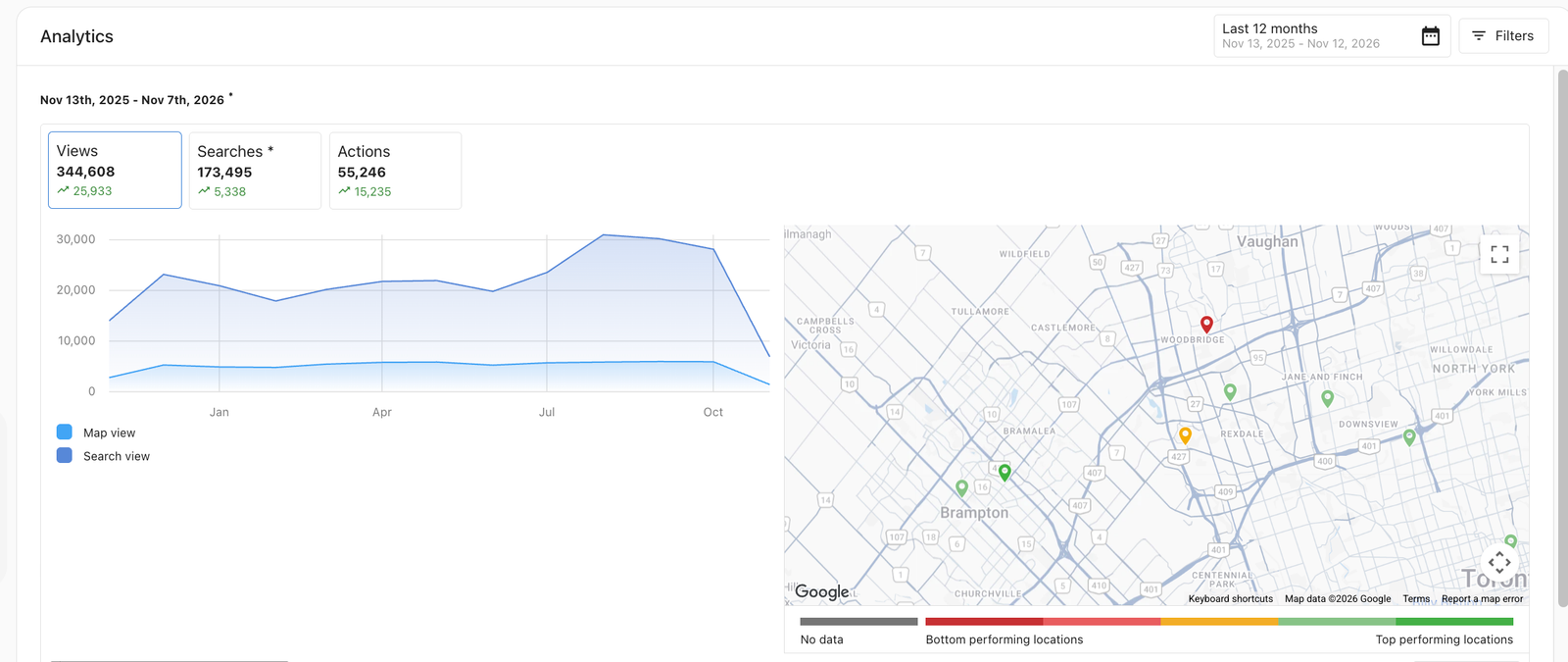
A real example from our client base. One of our multi-location financial services clients, an 11-location chain, gets over 80% of its monthly website traffic from organic search. Month after month. Over the last 12 months their Google Business Profiles pulled more than 340,000 views. And their web chat lead capture rate sits at 39.3%, nearly double the industry benchmark.
That isn't luck. It's clean data, active profile management, strong reviews and a website built for how search really works.
AI on our side of the table
Two different things get lumped together here. AI as a way customers find you. And AI as a tool we use to do the work.
The second one genuinely helps. Take review responses. Answering every review, on every platform, at every location, within 24 hours, by hand? Brutal. AI-assisted tools make that doable. And the replies have gotten better. More personal, closer to a brand's real voice.
Google's fine with it, too. They built an AI review reply feature right into Google Business Profile. What matters is whether the reply is good, not who typed the first draft.
We also use it to draft location content and watch local search signals. More gets done, faster. Clients get the benefit.
The real risk isn't AI
It's doing nothing. Set-and-forget is what hurts. A half-complete profile. Listings that disagree with each other. No plan for getting reviews. A website that never tells Google which city you're in.
But the bar keeps rising. Businesses with strong foundations are watching their lead grow, while the ones that cut corners lose visibility faster than before. Wait until you see a problem and your competitors already have a head start.
What to ask for
If you work with a local presence partner (or you're shopping for one), here's what to expect:
- Listings and profile management that doesn't stop. Not a one-time setup. Google changes its own platform constantly, and your management should keep up.
- A review strategy that produces volume and speed. Not just a widget on your site. A real system for asking, collecting and replying, at every location.
- A website that speaks to local and AI search. Clean location pages, schema markup, content that matches how your customers actually search.
- Reporting that connects the dots. Traffic, impressions, calls, direction requests and leads, broken out by location.
- A partner who watches where search is heading, not just where it's been.
Do this today: open your Google Business Profile and your website side by side. If the name, address, phone number or hours don't match exactly, fix that before anything else.
